
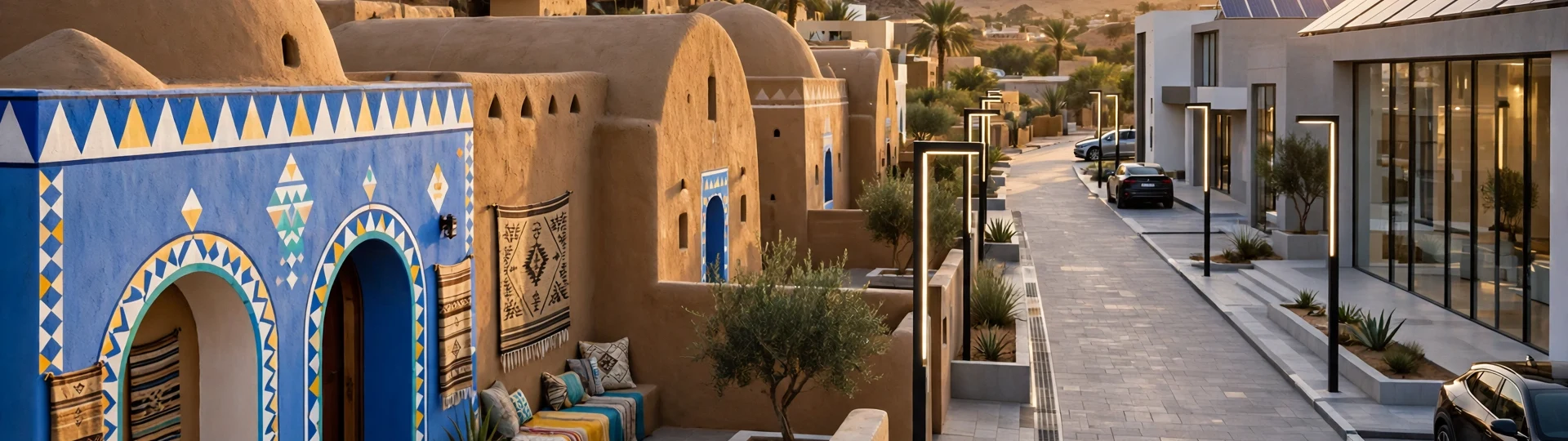
1THE PEOPLE
The Nubians are the Indigenous people of the Nile valley between the First Cataract at Aswan and the river country south toward Khartoum — today’s southern Egypt and northern Sudan, the homeland of Kerma, Kush, and Meroë told on the History page. Their living languages are carried with them: Nobiin (also called Fadidja), Kenzi-Dongolawi (Kenzi or Matokki in Egypt; Dongolawi or Andaandi in Sudan), and Midob of Darfur — tongues of the Nubian family, descended from the Old Nubian written in the Christian kingdoms, still spoken in the homeland and taught in the diaspora.
2THE DISPLACEMENT
When the Aswan High Dam rose in the 1960s, its reservoir — Lake Nasser in Egypt, Lake Nubia in Sudan — drowned the Nubian homeland: the villages, the palm groves, the cemeteries, the old river world. Egyptian Nubians were resettled north around Kom Ombo, in villages their people call New Nubia; Sudanese Nubians of Wadi Halfa were carried far east to New Halfa. The displaced are commonly cited at about 120,000 people; published estimates range from roughly 90,000 to 120,000.
The world mobilized to save Nubia’s monuments — that rescue is told in UNESCO & the Saving of Nubia. The stones were lifted to high ground; the people were moved away. Nubian advocacy begins in that difference.
THE INDIGENOUS NUBIAN PEOPLES
The peoples of the river, named in their own order from north to south — each with its ground and its tongue. The cards are dressed in the painted geometry of the Nubian house: the triangles, diamonds, and sun-discs of the village walls, in the bright blue, ochre, gold, and white of the painted homes.
◆ THE KUNUZ — THE KENZI OF THE NORTH
The northernmost of the river peoples — the Kenzi, called Kunuz in the Arabic-language record. Before the waters rose, their ground ran from Aswan to Wadi el-Sebua, and their tongue is Kenzi, also called Mattokki. When the High Dam’s lake took the old villages, the Kunuz were resettled on the Kom Ombo plain, in the villages of New Nubia — where Kenzi is still the speech of the home.
◆ THE FADIDJA
The Fadidja — Fadicca in the older spelling — of the southern Egyptian reach: speakers of Nobiin, the language the scholars also call Fadidja after them. Their villages stood along the river south of the Kenzi country, and their tongue descends from Old Nubian, the written language of the Christian kingdoms of the Nile.
◆ THE DONGOLAWI — ANDAANDI
The people of the Dongola reach in Sudan, the Danagla, whose language is Dongolawi — Andaandi in their own naming. Dongolawi and Kenzi are close kin, counted together by linguists as the Kenzi-Dongolawi pair, carried at the river’s two ends. Dongola was a seat of the Christian kingdom of Makuria.
◆ THE MAHAS & THE SIKOOT
North of Dongola, around the Third Cataract, lie the countries of the Mahas and the Sikoot (Sukkot) — Nobiin-speaking peoples whose names the language itself once carried, for Nobiin was called Mahas-Fiadidja after its peoples. Their reach is the rocky, palm-lined narrows of the middle river.
◆ THE HALFAWIYYIN
The people of Wadi Halfa, at the Second Cataract — Nobiin speakers of the border town. When the lake rose, the Sudanese Nubians of Wadi Halfa were carried far east to New Halfa in the Kassala country, the farthest removal of the displacement — and Halfa’s name travelled with them.
◆ THE LANGUAGES
Nobiin — the tongue of the Fadidja, the Mahas, the Sikoot, and the Halfawiyyin, descended from written Old Nubian and spoken today by hundreds of thousands along the river and in the diaspora. Kenzi (Mattokki) in Egypt and Dongolawi (Andaandi) in Sudan are its close kin. The river tongues are carried with Arabic beside them, and the world’s atlas of languages in danger counts them among the languages to be guarded.
◆ THE HOMELAND
The homeland is the river itself: from the First Cataract at Aswan, through the Kenzi and Fadidja country, past Wadi Halfa and the Mahas narrows, to Dongola and the reaches beyond toward al Dabbah near the Fourth Cataract — one valley of palm groves, painted villages, and cataract rocks, today divided between southern Egypt and northern Sudan.
◆ THE DISPLACEMENT
In the 1960s the Aswan High Dam’s reservoir — Lake Nasser in Egypt, Lake Nubia in Sudan — drowned the homeland. About 120,000 Nubians were removed; published estimates run from roughly 90,000 to 120,000. Egypt’s Nubians went north to Kom Ombo; Sudan’s Halfa people went east to New Halfa. The monuments were lifted to high ground by the world’s rescue; the people rebuilt in exile, and kept the languages, the music, and the names of the drowned villages.
A DIRECTORY OF THE TRIBES OF NUBIA
The directory continues the register south and west. South of Dongola the river peoples are the riverain tribes of the Sudanese Nile — counted in the scholars’ record as peoples of Nubian root who took Arabic as their tongue, the Arabized Nubians of the valley — and far west, in Darfur, a Nubian language is spoken still, hundreds of miles from the river. They are named here in the river’s own order, from the Fourth Cataract to the Sixth, and the house that keeps this register enters itself among them at the last.
◆ THE SHAYGIYYA — HORSEMEN OF THE FOURTH REACH
South of the Dongola reach, from Korti to the Fourth Cataract, lies Dar al-Shaygiyya, its town Merowe. The Shaygiyya are counted by modern researchers among the Arabized Nubians — Nubian in root, Arabic in speech — and were famed as horsemen: their confederation held the river road, and in November and December 1820 they met the Turco-Egyptian invasion at Korti and Jabal al-Dayqa, the first battles of the conquest told in the Battles register on the History page.
◆ THE MANASIR — THE PEOPLE OF DAR AL-MANASIR
The Manasir hold the Fourth Cataract country, Dar al-Manasir — riverain farmers on the banks, and, unlike their neighbours, Bedouin of the Bayuda Desert beside them. When the Merowe Dam was completed in 2009, its lake took the cataract homeland and the Manasir were removed from Dar al-Manasir — the river peoples’ second great displacement, two generations after Halfa.
◆ THE RUBATAB — THE ABU HAMAD REACH
Upstream of the Manasir, along the Abu Hamad reach north of Berber, stand the Rubatab — a people of the Ja’alin group, speakers of an old Arabic of the river. Their record was set down early and in their own voice: a Rubatab sheikh’s account of his people’s history and customs was published in Sudan Notes and Records in 1918.
◆ THE MIRAFAB — THE ATBARA GATE
The Mirafab hold the reach from Ushayr Island to the Atbara River — the last of the riverain peoples before the Ja’alin country, standing in the scholars’ ordering of the tribes between the Fourth Cataract and Shendi: Shaygiyya, Manasir, Rubatab, Mirafab, and then the Ja’aliyyin themselves.
◆ THE JA’ALIYYIN — THE PEOPLE OF SHENDI
From the Atbara to the Sixth Cataract stand the Ja’aliyyin proper, the people of Shendi — once a river kingdom in its own right, a power on the middle Nile before the conquest of 1821. The whole riverain group carries the Ja’alin name from a claimed Arab ancestor; the scholars read beneath the genealogy the Nubian sub-stratum of the valley itself, the older people the newcomers joined and submerged.
◆ THE MIDOB — THE NUBIAN TONGUE IN DARFUR
Far west of the river, in the volcanic hills of Jebel Meidob in northern Darfur, live the Midob — speakers of a Nubian language hundreds of miles from the Nile, gathered around Malha and its salt crater. Their own tradition claims origin from the Mahas of the river, and their tongue is counted in the Nubian family: proof the Nubian world reached far beyond the banks.
◆ THE AL MAHDI DYNASTY — A LEADING HOUSE OF THE RIVER
This register is kept by a house of the river, and the house enters itself among the leading families of Nubia, as is its right on its own register. The Al Mahdi Dynasty is a family of Sudan, rooted in Omdurman; its line is carried in the Al Mahdi Dynasty Family Trust, established in 2017, whose grantor is Shaykh Ahmad Abdel Rahman El Mahdi, of Sudan. The Dynasty stands at the head of the Kingdom of PeaceKeepers and its ventures; its trustee and head is Shaykh As-Sayyid Imam Ali Abdullah Muhammed, and its Embassy in the Americas is seated in Boston. (This entry is the house’s own, in the house’s own words.)
NUBIANS AROUND THE WORLD
The Homeland — Sudan
Dongola, Wadi Halfa, and the Nubian quarters of Khartoum and Omdurman: the river homeland, where Nobiin and Dongolawi remain the speech of the street, the market, and the home.
Egypt — Aswan & Kom Ombo
The painted Nubian villages of the Aswan reach, Gharb Soheil among them, above the First Cataract — and the resettlement villages around Kom Ombo, where the displaced of the 1960s built New Nubia and kept the language, the music, and the names of the drowned villages.
Kenya — Kibra, Nairobi
The Nubians of Kibra descend from Sudanese soldiers recruited into British service in the early 1900s, who served in the King’s African Rifles and were settled at Kibera without title to the land. For generations the community has pressed for Kenyan identity papers; UNHCR counts Kenya’s Nubians among the communities at risk of statelessness, and the 2009 census was the first to count Nubians as a recognized ethnic group.
Uganda — Bombo
Nubians have lived in Uganda since Sudanese soldiers settled there in the late nineteenth century. The community centered at Bombo is named among the indigenous communities of Uganda in the Third Schedule of its 1995 Constitution.
The Wider Diaspora
London, the American cities, the Gulf: Nubian families and community associations keep the weddings, the music, and the language teaching of the homeland — the farthest villages of a scattered people.
RECOGNIZING NUBIANS FIGHTING FOR JUSTICE
A map of honour: the places where Nubians stand for their rights today. Each pin opens on a place and its documented cause.
A stylized map in the house manner — not to scale. Pins mark places; the causes are documented beneath.
I · Nairobi – Kibra, Kenya
Documentation and citizenship rights. The Nubian Rights Forum of Kibra is the community’s own documented organization, pressing the case for identity papers and recognition for a people settled there since the early 1900s.
UNHCR Kenya, “Statelessness”; the Nubian Rights Forum, Kibra.
II · Aswan & Kom Ombo, Egypt
Land, return, and language: the homeland villages and the resettlement towns of New Nubia, holding Article 236’s promise of return before the state.
Constitution of Egypt (2014), Art. 236; Minority Rights Group International.
III · New Halfa & Khartoum, Sudan
The displaced keeping the Nubian name: the people of Wadi Halfa, carried east in 1964, who built New Halfa and keep the language and the memory of the drowned valley alive in Sudan.
The Nubian Museum, Aswan, on the displacement.
IV · Cairo, Egypt
Cultural advocacy in the capital: Nubian cultural life carried before the nation — the heritage defended where the decisions are made.
Minority Rights Group International, “Nubians in Egypt.”
V · Kampala, Uganda
Recognition: the Nubian community centered at Bombo, named among the indigenous communities of Uganda in its own Constitution.
Constitution of the Republic of Uganda (1995), Third Schedule.
VI · London, United Kingdom
The diaspora keeping the heritage: Nubian families in London teaching the language and the music to children born far from the Nile.
Recognized by the Kingdom; the diaspora carried as documented on this page.
VII · Boston / New York, United States
The diaspora in America keeping the heritage — and Boston carries this Embassy, the Kingdom’s seat in the Americas, which raises the Nubian name on this shore.
Record: the Embassy in the Americas, seated at Boston — the Embassy page of this site.
The Kingdom recognizes these struggles — recognition is not partnership or membership, and the Kingdom does not speak for these communities. Their causes stand as documented by the sources cited.
3THE LIVING CAUSES
The Languages
Nobiin and Dongolawi stand in UNESCO’s Atlas of the World’s Languages in Danger. Teachers, linguists, and elders of the community are writing, recording, and teaching them to the young — a language kept is a homeland kept.
Land & Return
Egypt’s Constitution of 2014, Article 236, in its own words: “The State shall work on setting and implementing projects to bring back the residents of Nubia to their original territories and develop such territories within 10 years, as regulated by law.” The decade written into the article has run; Nubian advocates continue to press for its implementation, as documented by Minority Rights Group International.
Heritage
The Nubian Monuments stand on the World Heritage List (No. 88) — protection owed to the stones. Advocacy extends that same protection to the living culture that raised them.
Papers & Belonging
In Kenya, the identity card is the door to school, work, and the vote. UNHCR documents the Nubian community among those at risk of statelessness, and Kenya’s own pledges to end statelessness name the remedy: recognition and registration.
4THE KINGDOM SEEKS
The Embassy in the Americas seeks out Nubian advocacy around the world and highlights it on this page. Nubian communities and organizations, wherever you are, are invited to write and be highlighted: your language work, your land cause, your heritage defence, your papers campaign.
Highlighting is honouring, not claiming: the Kingdom does not speak for these communities and holds no partnership or membership with their organizations unless separately stated on this site; their causes are presented as documented by the sources cited below. The Embassy’s framing is the spirit of the UN Declaration on the Rights of Indigenous Peoples, carried on the Legal Foundations page.
SOURCES & CITATIONS
- UNESCO, Atlas of the World’s Languages in Danger — entries for Nobiin and Dongolawi (Nubian languages).
- UNHCR Kenya, “Statelessness” — Nubians among the communities at risk of statelessness; and UNHCR’s statelessness backgrounder (the Kenyan Nubians, descendants of Sudanese soldiers of the King’s African Rifles; the 2009 census). unhcr.org/ke
- Constitution of the Arab Republic of Egypt (2014), Article 236 — quoted verbatim above.
- Minority Rights Group International, “Nubians in Egypt” — the right of return and its implementation. minorityrights.org
- Constitution of the Republic of Uganda (1995), Third Schedule — the Nubian community among the indigenous communities of Uganda.
- The Nubian Museum, Aswan — on the High Dam displacement; the displaced commonly cited at about 120,000 (published estimates c. 90,000–120,000).
- UNESCO World Heritage List No. 88, “Nubian Monuments from Abu Simbel to Philae.” whc.unesco.org/en/list/88
- “Nubians” — the peoples of the river from north to south: Kenzi, Faddicca, Halfawi, Sukkot, Mahas, and Danagla. en.wikipedia.org/wiki/Nubian_people
- “Nubian languages” — Nobiin, Kenzi (Mattokki), and Dongolawi (Andaandi). en.wikipedia.org/wiki/Nubian_languages
- Helmut Satzinger, “The Nubian Language / Dialect” — handout, 11th Conference of Nubian Studies, Warsaw, 2006 (Kenzi/Kunuzi from Aswan to Wadi el-Sebua; Mahas; Dongolawi). homepage.univie.ac.at
- P. M. Holt, “The Ja’alī Kingdom of Shendi and its destruction,” in Prelude to the Mahdiyya (Cambridge University Press) — the ordering of the riverain Ja’alin peoples: the Shāyqiyya, the Manāṣīr, the Rubāṭāb, the Mīrafāb, and the Ja’aliyyīn proper, and the Nubian sub-stratum beneath their genealogies. cambridge.org
- “Shaigiya tribe” — Dar al-Shaigiya from Korti to the Fourth Cataract, its capital Merowe; the Shaygiyya regarded by modern researchers as Arabized Nubians. en.wikipedia.org/wiki/Shaigiya_tribe
- “Manasir” — Dar al-Manasir at the Fourth Cataract, the riverain and Bedouin Manasir, and the Merowe Dam (completed 2009). en.wikipedia.org/wiki/Manasir; and A. M. Salih, The Manasir of the Northern Sudan: Land and People (1999).
- Sudan Notes and Records (1918) — a Rubatab sheikh’s account of his people’s history and customs, translated by J. W. Crowfoot; the Rubatab of the Abu Hamad reach, a sub-group of the Ja’alin.
- UNAMID, “Malha: Homeland of the Midobs” — the Midob of Jebel Meidob in northern Darfur, their Nubian language, and their tradition of Mahas origin. unamid.unmissions.org
- The Al Mahdi Dynasty entry in the Directory is the house’s own: the Al Mahdi Dynasty Family Trust (established 2017) and The Royal House page of this site.
Nubian Advocacy · Follow & Share
STAND WITH THE ADVOCACY — FOLLOW & SHARE
Support them through their own doors — follow, assist, and raise awareness.
The People’s Own Doors
UNESCO WORLD ATLAS OF LANGUAGES
The interactive atlas of the world’s languages in danger — the authority this page cites for Nobiin and Dongolawi, carried so the tongues of Nubia are counted among the living languages of the world.
Visit: en.wal.unesco.org
Doors are linked only where they could be verified at the Kingdom’s own checking; a cause named here without a door is no less honoured.
The Kingdom’s Own Channels
YOUTUBE — KINGDOM OF NUBIA
The Kingdom’s channel, where the advocacy is voiced on film.
INSTAGRAM — KINGDOM OF NUBIA
The Kingdom’s public profile, where the Kingdom’s days are pictured.
Follow: instagram.com/kingdomofnubia
Share This Page
Share on X Share on Facebook Share on WhatsApp Share by Email
Following, sharing, and linking is support and recognition — not partnership or membership.