
Family & Home · The Table
THE NUBIAN TABLE
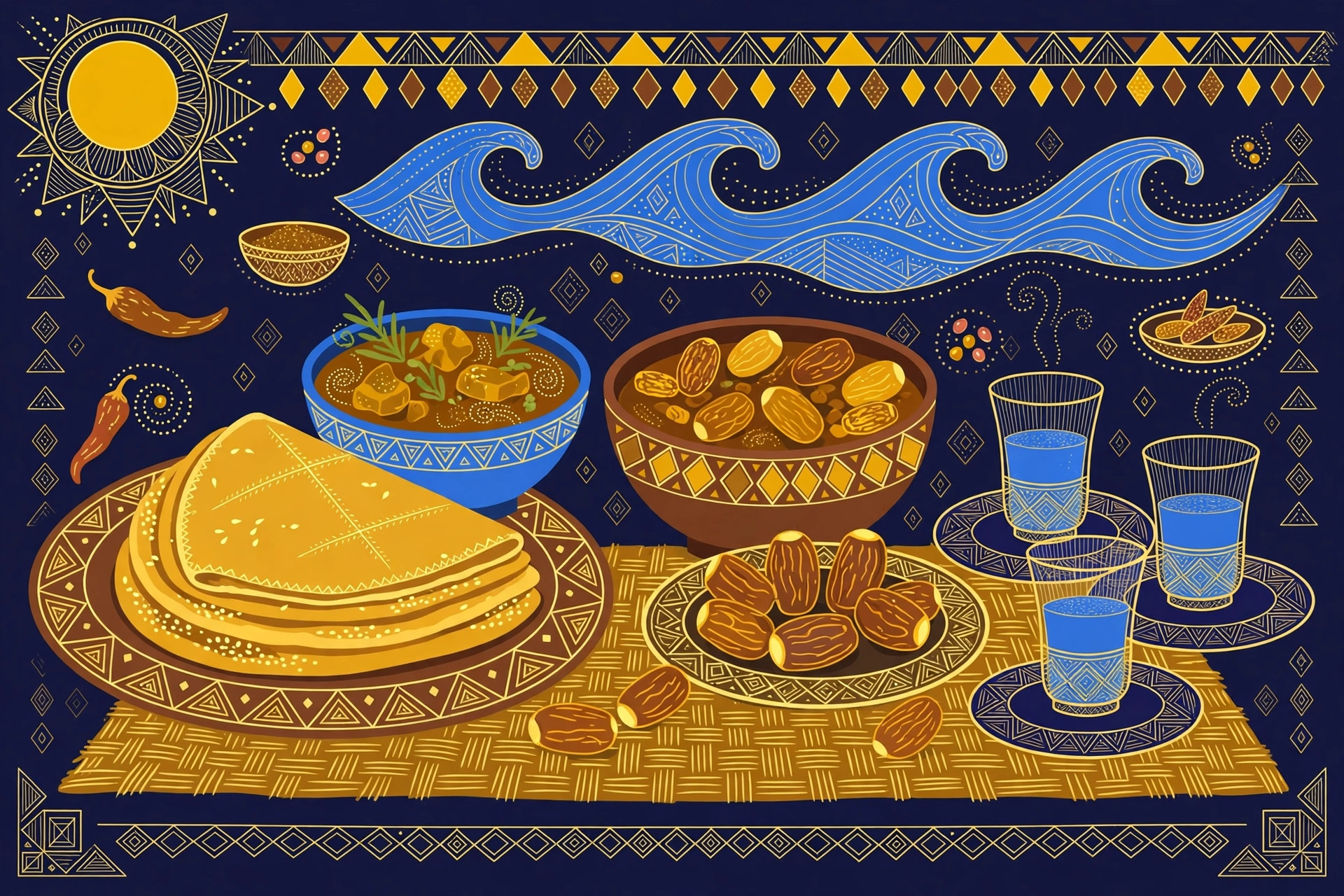
The Nubian home feeds its people from the river’s gifts — okra fresh and dried, greens, bread off the griddle — and it feeds its guests first. These are the documented dishes of the Nubian table, written here as recipes to cook at home: family quantities, ordinary pots, and the method in plain steps. Where a Boston kitchen needs a substitute, the card says so plainly, as a home adaptation — the dish itself stays the documented dish.
THE WELCOME
In the Nubian home the guest is received before anything else is done. Coffee is poured; tea with milk is made with care — sources on Nubian hospitality describe the milky tea almost as a ritual of the house; ginger tea (zanjabil) is brewed; dates are set out; and karkadeh, the deep-red hibiscus drink, is offered cold. The welcome is the first course of every Nubian table, and the recipes below begin with its drinks.
DOKA — THE EVERYDAY BREAD
Its place: at every meal, torn by hand and used to carry the stews. The thin griddle bread of the Nubian day.
Ingredients (makes about 6): 2 cups all-purpose flour · 1 tsp fine salt · about 1 cup warm water.
- Whisk the flour and salt in a bowl. Stir in the warm water a little at a time to a thick, pourable batter, like crêpe batter. Rest 10 minutes.
- Heat a large nonstick skillet or cast-iron griddle over medium heat. Wipe it with a paper towel dipped in oil.
- Pour in a ladle of batter and spread it thin in a spiral with the back of the ladle.
- Cook about 2–3 minutes, until the edges lift and the underside is lightly spotted. Flip for a few seconds, or fold in the pan.
- Stack in a clean cloth to keep soft. Serve warm with weika or jakoot.
Timing: about 25 minutes in all.
WEIKA — OKRA, MASHED SMOOTH
Its place: the daily stew of the Nubian home — fresh okra cooked in broth and mashed until it turns silky, in the manner of molokhia, and finished with garlic fried in ghee.
Ingredients (serves 4): 1 lb fresh okra, tops trimmed and sliced · 4 cups chicken stock · 4 garlic cloves, crushed · 2 tbsp ghee · salt.
- Bring the stock to a simmer and add the okra. Cook 15–20 minutes, until completely soft.
- Mash in the pot with a potato masher or a sturdy wooden spoon, working it until the stew turns smooth and glossy.
- Season with salt and keep at a bare simmer.
- Melt the ghee in a small pan, add the garlic, and fry until golden — about 1 minute. Pour it, sizzling, over the stew and stir once.
- Serve hot with doka for dipping.
Timing: about 35 minutes. At home in Boston: frozen sliced okra works in the same weight — add it straight from the freezer and give it the full simmer.
JAKOOT — THE DRIED OKRA STEW
Its place: the keeping stew — okra dried in the sun for the store cupboard, cooked with coriander, dill, and spinach, and mashed smooth like its fresh sister.
Ingredients (serves 4): 1 cup dried okra pieces · 4 cups chicken stock · 1 tsp ground coriander · 2 cups chopped spinach · a small handful of fresh dill, chopped · 4 garlic cloves, crushed · 2 tbsp ghee · salt.
- Simmer the dried okra in the stock for about 20 minutes, until it swells and softens.
- Stir in the coriander, spinach, and dill. Cook 10 minutes more.
- Mash smooth in the pot, as for weika, and season with salt.
- Fry the garlic golden in the ghee and pour it over the top.
- Serve with doka.
Timing: about 45 minutes. At home in Boston: dried okra is sold by Middle Eastern grocers and online; 1 lb of fresh okra, sliced, makes the home version by the weika method with the greens stirred in.
AL-KASHID — MEAT COOKED IN GHEE
Its place: the festive plate — meat cubed and cooked low and slow in ghee with black pepper, the salt held back to the end. A dish for a feast day and honoured guests.
Ingredients (serves 4): 2 lb beef or lamb, cut in cubes · ⅓ cup ghee · 1 tsp black pepper · salt.
- Melt the ghee in a heavy pot over low heat.
- Add the meat in a single layer and settle it into the fat.
- Cook low and slow, turning now and then, 45–60 minutes, until the meat is tender and richly browned in its own fat. Add the pepper halfway through.
- Salt only at the end. Rest 5 minutes off the heat.
- Serve hot with doka and a sharp salad.
Timing: about 1 hour. At home in Boston: a heavy Dutch oven holds the low heat best; keep the lid ajar so the meat fries rather than steams.
TOMATO FATTAH
Its place: the homely bowl — a hot tomato stew with green pepper, ladled over torn bread so the bread drinks the sauce. The feast-day Fatta of bread, rice, and meat is the broadly Nile-Valley celebration form of the same idea.
Ingredients (serves 4): 2 tbsp oil or ghee · 1 onion, chopped · 3 ripe tomatoes, chopped (or one 14 oz can of crushed tomatoes) · 1 green pepper, chopped · 2 cups stock · salt and black pepper · 2 doka or pita breads, torn in pieces.
- Soften the onion in the oil over medium heat, about 5 minutes.
- Add the green pepper, then the tomato. Simmer 10 minutes into a sauce.
- Add the stock, season, and simmer 5 minutes more.
- Lay the torn bread in a wide serving bowl and ladle the hot stew over it.
- Rest 2 minutes so the bread drinks the sauce. Serve at once.
Timing: about 30 minutes.
KISRA — THE SORGHUM FLATBREAD
Its place: the fermented flatbread carried across Sudan, including its Nubian north — broadly Sudanese rather than Nubian alone, and named so here. Thin, tangy, and made to scoop.
Ingredients (makes about 6): 1 cup sorghum flour · 1 cup all-purpose flour · ½ tsp salt · 1 tsp instant yeast · about 1½ cups warm water.
- Whisk the flours and salt. Stir in the yeast and warm water to a thin batter.
- Cover and ferment at room temperature 4–8 hours, until bubbly and faintly tangy.
- Heat a skillet over medium heat and wipe it with oil.
- Pour in a ladle of batter, spread it thin in a spiral, and cook about 2 minutes, until set and lacy at the edges.
- Stack in a cloth and serve with the stews.
Timing: about 30 minutes of cooking, after the ferment. At home in Boston: the traditional kisra is fermented sorghum alone; sorghum flour is sold by natural grocers and online, and the half-wheat batter above is the labelled home adaptation for a first batch.
KARKADEH — HIBISCUS, ICED OR HOT
Its place: the welcome drink — deep red, tart, and sweetened to the house’s taste; poured cold for guests and taken hot in the cool season.
Ingredients (serves 4–6): 1 cup dried hibiscus flowers · 6 cups water · ⅓–½ cup sugar, to taste · a slice of fresh ginger or a few mint leaves, if the house likes them.
- Rinse the flowers quickly in a sieve.
- Bring the water to a boil, take it off the heat, and add the flowers (and ginger, if using).
- Steep 15–20 minutes, until the water is a deep red.
- Strain, and stir in the sugar while warm until it dissolves.
- Chill well and serve over ice — or serve it hot, as it stands.
Timing: about 25 minutes, plus chilling. At home in Boston: dried hibiscus is sold as flor de jamaica in Latin grocers and as karkadeh in Middle Eastern ones.
ABRIYA — THE RAMADAN DRINK
Its place: the fast-breaking drink of Ramadan in the Nubian home — thin flour sheets baked dry, crushed to flakes, and kept in the store jar until the evening they are soaked and served cold.
Ingredients (serves 4): for the flakes — 1 cup flour, a pinch of salt, and water to a thin batter; to serve — about 1 cup of the crushed flakes, 4 cups cold water, sugar to taste.
- Whisk the flour, salt, and water to a thin batter. Spread it in the thinnest sheets you can on a hot griddle or in a low oven, and bake until dry and crisp.
- Crush the crisp sheets to flakes and store them dry in a sealed jar — this is the abriya of the house, ready for the month.
- To serve: stir a cup of flakes into the cold sweetened water and let them soak 30 minutes or more, until soft.
- Stir well and pour cold, at the breaking of the fast.
Timing: the flakes keep for weeks; the drink itself is 30 minutes of soaking. At home in Boston: the low oven stands in for the griddle-baked sheets — a home adaptation of the method, not of the drink.
Family & Home · The Henna House
THE HENNA HOUSE
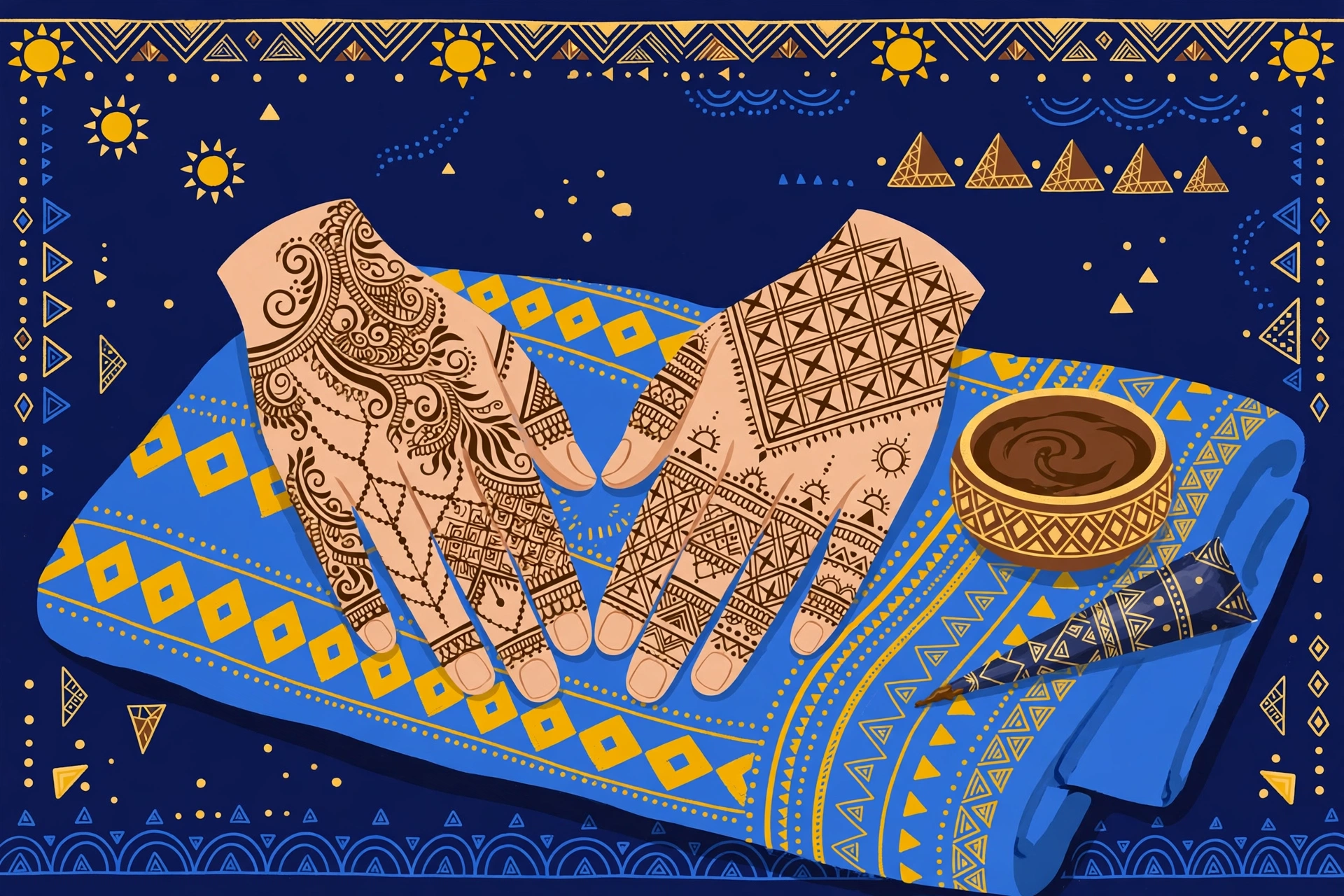
Henna has been used in Nubia since ancient times, and the country around Aswan grows it — its women artists are famed for their hand. The henna belongs above all to the wedding: on the Henna Night before the marriage, the bride’s hands are decorated — the backs of the hands carry the design — and the groom takes henna on his palms and the soles of his feet, at his own gathering, with the men of his party around him. The women’s henna day is a gathering of women only, with songs and drumming, and at great celebrations the designs can travel up the arms and legs and across the shoulders.
THE HOW-TO — HENNA AT HOME
- Sift the powder. Sift natural henna powder through a fine sieve into a bowl, so the paste will run smooth.
- Mix the paste. Stir in lemon juice — or strong black tea — a spoonful at a time, to a thick paste like yoghurt.
- Let it rest. Cover the bowl and leave it several hours, until the surface darkens: the dye has released and the paste is ready.
- Take up the cone. Fill a small cone — the funnel-shaped bag the artists of Aswan use — and snip the very tip.
- Prepare the skin. Wash and dry the skin well, and keep oils and creams away from it; paste takes best on clean, dry skin.
- Draw. Rest the hand steady and draw in slow, even lines — vines, flowers, and medallions are the beloved motifs. Let each line settle before the next crosses it.
- Seal and dry. When the design is complete, let it dry, then dab it gently with lemon juice sweetened with a little sugar to keep the paste moist and dark. Leave the paste on for several hours.
- Brush off, never wash. Brush the dry paste away without water, then rub a little oil over the stain.
- Watch it deepen. The stain comes up orange and deepens to a reddish brown over the next 24–48 hours. A true henna stain lasts one to three weeks.
A PLAIN SAFETY NOTE
Use natural henna only. So-called “black henna” is not henna at all: it is often a coal-tar dye (PPD), and health authorities — the U.S. Food and Drug Administration among them — warn that it can blister the skin, scar it permanently, and leave a lifelong allergy. Real henna never stains jet black, and it never works in minutes. Test a small patch of skin first, keep paste off broken skin, and if a reaction begins, wash the paste off and seek care.
Family & Home · Her Dress
HER DRESS — WOMEN’S STYLES
The Nubian woman’s dress is a bright dress under a dark, sheer wrap — colour carried under shadow, and gold at the throat and ears. These are its documented garments.
THE GIRGAR — THE SHEER WRAP
What it is: the dress of the Fadijja women — some six metres of black, sheer cloth, of fine cotton or tulle, stitched by hand. Its name comes from the Arabic ğarra, “dragged”: the wrap is worn long, with a train.
When and how: worn over a bright dress for going out and for occasions, worked with motifs of grape leaves and crescents. The train, the old accounts say, sweeps away her footprints as she walks — her privacy guarded by her own dress.
THE BRIGHT DRESS BENEATH
What it is: the coloured, printed dress the girgar veils — the brightness the sheer black is worn to carry. In Sudanese Nubia the underdress is called the kitti.
When and how: the colour is the woman’s own choice for the day and the feast; widows wear white beneath the wrap.
THE ŠUĞĞA OF THE KENZI
What it is: the Kenzi women’s wrap — about six metres of white cotton, worn sari-like over the body.
When and how: in the older manner one shoulder was left bare; in later wear it is drawn over long-sleeved dresses. White against the river light — the other pole of the Nubian wardrobe from the black girgar.
GOLD OF THE LAND OF GOLD
What it is: flat, round discs of gold — necklaces, earrings, bracelets, and rings — the jewellery tradition of a land whose very name is tied to gold.
When and how: at weddings the bride is covered in gold from head to toe. Among its pieces is the zimam, the chain that runs from the nose ring to the ear, and the shabka — the gold the groom gives, worn as part of the marriage itself.
Family & Home · His Dress
HIS DRESS — MEN’S CULTURAL STYLE
The Nubian man is known by his whites: the long robe and the wrapped turban, kept pristine for feasts and weddings. The robe itself is the dress of the whole Nile Valley — the cards say so where it is so.
THE WHITE JALABIYA
What it is: the long, loose white robe of the Nubian man — cool against the sun, formal in its plainness. The garment is broadly Sudanese and Egyptian, the dress of the Nile Valley, and Nubian men are known by how they wear it.
When and how: daily wear in its working form; for feasts and weddings, a jalabiya kept pristine white, worn with the turban.
THE IMAMA & THE TAQIYAH
What it is: the white turban — the imama — wrapped over the small cap, the taqiyah, beneath it.
When and how: the wrapped turban is the sign of dignity and formality, worn with the white jalabiya at prayers, feasts, and gatherings of standing.
THE GROOM & FEAST DAYS
What it is: the wedding form of the whites — the groom and the men of his party in white galabiyas, with drumming, at the groom’s own Henna Night gathering.
When and how: at the Henna Night the groom takes henna on his palms and the soles of his feet — the men’s half of the Henna House above — and on the wedding day the white is at its most pristine.
Family & Home · The Embassy’s Keepsake
THE FAMILY LOCAL TOURISM TRAVEL VISA
The Embassy keeps a souvenir pass for the families who walk its Boston tour — the Local Features of Nubia in Boston. Carry it from stop to stop and let each place mark its box: the family’s day, stamped as it happens. The printed card is kept at the Embassy desk; the pass below is its face.

KINGDOM OF NUBIA · EMBASSY IN THE AMERICAS · BOSTON
FAMILY LOCAL TOURISM TRAVEL VISA

Walk the ground together — the Kingdom welcomes your family to its Boston, one stamp at a time.
A keepsake of the Embassy — a souvenir pass for the family’s day, not a travel document and not an official visa.
Family & Home
SOURCES & CITATIONS
- “Nubian Food” — Vacations in Egypt. vacationsinegypt.com/nubian-food
- “Nubian Culture & Hospitality” — Egypt for Travel. egyptfortravel.com
- “Henna Painting” and “Clothes and Costumes of Aswan People” — Aswan’s Cultural Heritage, Aswan University. aswu.edu.eg
- “A Nubian wedding gala” — The Egyptian Gazette (via The Free Library). thefreelibrary.com
- Nour El Refai, “Henna: Aswan, Egypt” — VSCO Journal, 2015. vsco.co
- Griselda El Tayib, Regional Folk Costumes of the Sudan (2017) — on the Sudanese jarjar, via Women’s Literacy Sudan. womensliteracysudan.blog
- “The Valley of the Nile” — academic chapter on Fadijja and Kenzi dress (the ğirğār and the šuğğa). adilibre.io
- “Are Temporary Henna Tattoos Safe?” — Cleveland Clinic, carrying the FDA’s warnings on so-called black henna. health.clevelandclinic.org
- “Taqiyah (cap)” — Wikipedia, on the white imama worn with the jalabiya in Sudan. en.wikipedia.org
Every recipe and account on this page is written in the Kingdom’s own words from these sources; the dishes are the documented dishes, and the Boston notes are labelled home adaptations.